

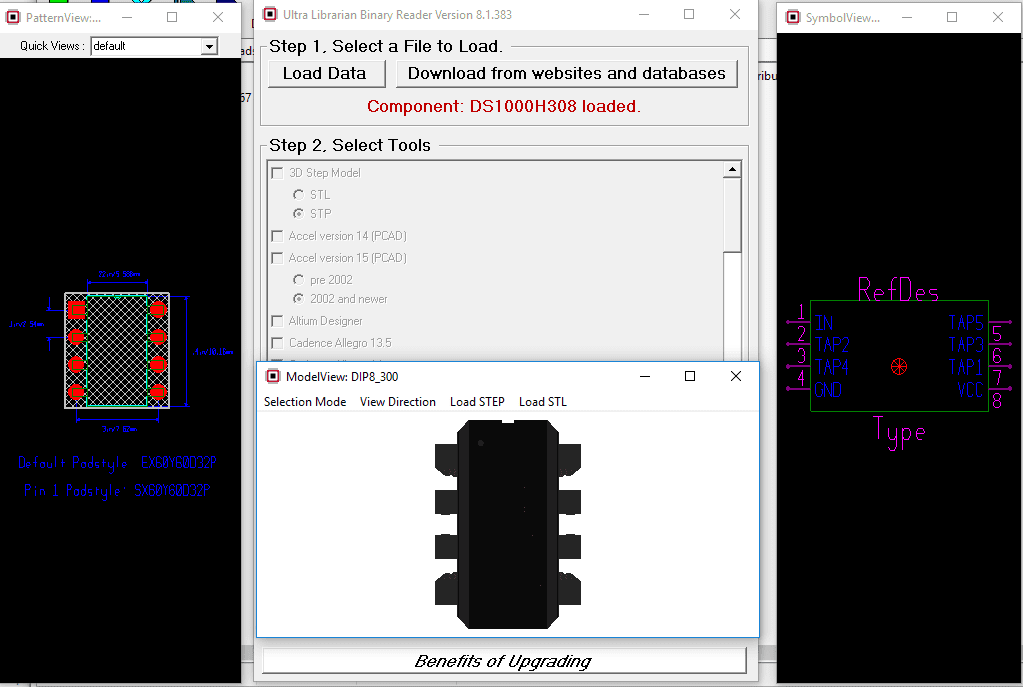
CREATE SYMBOLS, FOOTPRINTS, AND 3D MODELS FROM PRE-AUTHORED DATA

ULTRA LIBRARIAN FREE READER

Preview models prior to downloading

Choose from over 20 different CAD export options

SS-Vio-018_v.7z.001
CONVERT BXL FILES INTO YOUR PREFERRED CAD FORMAT

The free reader is a lite version of Ultra Librarian specifically designed to import vendor neutral CAD data (.bxl files) from manufacturers’ websites and then export symbols, footprints, and 3D models to specific CAD tool formats. The reader is a read-only tool and will not allow users to make any changes to the data. For symbols, footprints, and 3D model creation capabilities, use one of the Ultra Librarian Desktop Software options.

BXL FILES FROM YOUR FAVORITE IC MANUFACTURERS

Many of our IC partners offer BXL files for their components directly on their websites. Once you have obtained a BXL file it is quick and easy to convert to your preferred CAD format through our online BXL conversion tool.

Check out all manufacturers here.

EXPORT TO OVER 30 DIFFERENT CAD FORMATS

VENDOR NEUTRAL FILES

Accel EDA 14 & 15

  • DesignSpark
  • Mentor Graphics
  • BoardStation
  • Mentor Graphics Design Architect
  • Mentor Graphics Design
  • Expedition 99 and 2000
  • PCAD 2000, 2001, 2002, 2004, and 2006
  • STL
  • TARGET 3001!
  • View Logic ViewDraw
  • Zuken CadStar 3 and 4
  • Zuken CR-5000 and CR-8000

FREQUENTLY ASKED QUESTIONS

A .BXL file contains electronic data created by Ultra Librarian in a universal format and is used for distributing PCB information. .BXL files can be opened by the Ultra Librarian Free Reader and translated into your choice of 22 different CAD formats.

Ultra Librarian has partnered with major IC manufacturers to create electronic data representing their parts and are available to the public. Partners include Analog Devices, Texas Instruments, Microchip, Maxim, Silicon Labs, Renesas, Exar, and NXP.

Yes, you can use our Online Reader if you don’t want to download the Free Reader

Free Reader

"*" indicates required fields

There is a profound irony in the use of high-compression formats like .7z . While they are designed to preserve space, they are also inherently fragile. If part .001 is corrupted or its subsequent parts are lost, the entire archive may become unreadable. This "all-or-nothing" nature of compressed files mirrors the fragility of historical memory. Without the full set of files and the correct decryption keys, the information within remains a digital ghost—occupying physical space on a server but contributing nothing to our understanding of the world. Conclusion

The prefix "SS-Vio" often acts as a taxonomy for "Shared Services" or "Sensitive-Violations." When we encounter such naming conventions, the essay moves from the technical to the ethical. Filenames are the first layer of metadata; they provide a "map" to the contents while often masking the raw reality of what lies within. If this file contains records of violations—whether legal, human rights, or corporate compliance—the filename itself becomes a shield, a way to categorize human experiences or organizational failures into a sterile, searchable format. This abstraction is necessary for processing but risks distancing the analyst from the gravity of the data. The Fragility of Compressed Memory

In the contemporary digital landscape, much of our collective history and institutional data is stored not in physical vaults, but within the nested hierarchies of compressed archives. A file labeled serves as a perfect microcosm of this reality. To the casual observer, it is a cryptic string of alphanumeric characters; to a researcher or data architect, it represents a structured, segmented vessel of information that requires specific keys—both technical and ethical—to unlock. The Technical Anatomy of Persistence

An essay on is ultimately a reflection on how we choose to package our past and present. It highlights the tension between the need for efficient data management and the ethical imperative to keep information accessible and meaningful. Whether this specific file contains administrative logs or historical testimony, it stands as a testament to the complex, fragmented, and often hidden ways we store the truth in the 21st century.

The suffix .7z.001 immediately identifies this as a "split archive." In an era where datasets can reach terabytes in size, the 7-Zip format allows large volumes of data to be broken into manageable fragments. This segmentation is a fundamental strategy for digital persistence, ensuring that data can be transmitted over limited bandwidths or stored across multiple physical drives without loss of integrity. The "018" designation suggests a serialized collection—part of a larger body of work (perhaps the 18th volume or case) that reflects the meticulous nature of modern digital archiving. Metadata and the Power of Naming

Below is an essay that explores the implications of such a file from the perspectives of digital preservation, data ethics, and the role of compressed archives in modern information management.

The Architecture of the Unseen: Deciphering the Digital Archive SS-Vio-018

the pcb design, assembly, and trends blog

RELATED CONTENT

Ss-vio-018_v.7z.001 May 2026

There is a profound irony in the use of high-compression formats like .7z . While they are designed to preserve space, they are also inherently fragile. If part .001 is corrupted or its subsequent parts are lost, the entire archive may become unreadable. This "all-or-nothing" nature of compressed files mirrors the fragility of historical memory. Without the full set of files and the correct decryption keys, the information within remains a digital ghost—occupying physical space on a server but contributing nothing to our understanding of the world. Conclusion

The prefix "SS-Vio" often acts as a taxonomy for "Shared Services" or "Sensitive-Violations." When we encounter such naming conventions, the essay moves from the technical to the ethical. Filenames are the first layer of metadata; they provide a "map" to the contents while often masking the raw reality of what lies within. If this file contains records of violations—whether legal, human rights, or corporate compliance—the filename itself becomes a shield, a way to categorize human experiences or organizational failures into a sterile, searchable format. This abstraction is necessary for processing but risks distancing the analyst from the gravity of the data. The Fragility of Compressed Memory SS-Vio-018_v.7z.001

In the contemporary digital landscape, much of our collective history and institutional data is stored not in physical vaults, but within the nested hierarchies of compressed archives. A file labeled serves as a perfect microcosm of this reality. To the casual observer, it is a cryptic string of alphanumeric characters; to a researcher or data architect, it represents a structured, segmented vessel of information that requires specific keys—both technical and ethical—to unlock. The Technical Anatomy of Persistence There is a profound irony in the use

An essay on is ultimately a reflection on how we choose to package our past and present. It highlights the tension between the need for efficient data management and the ethical imperative to keep information accessible and meaningful. Whether this specific file contains administrative logs or historical testimony, it stands as a testament to the complex, fragmented, and often hidden ways we store the truth in the 21st century. This "all-or-nothing" nature of compressed files mirrors the

The suffix .7z.001 immediately identifies this as a "split archive." In an era where datasets can reach terabytes in size, the 7-Zip format allows large volumes of data to be broken into manageable fragments. This segmentation is a fundamental strategy for digital persistence, ensuring that data can be transmitted over limited bandwidths or stored across multiple physical drives without loss of integrity. The "018" designation suggests a serialized collection—part of a larger body of work (perhaps the 18th volume or case) that reflects the meticulous nature of modern digital archiving. Metadata and the Power of Naming

Below is an essay that explores the implications of such a file from the perspectives of digital preservation, data ethics, and the role of compressed archives in modern information management.

The Architecture of the Unseen: Deciphering the Digital Archive SS-Vio-018